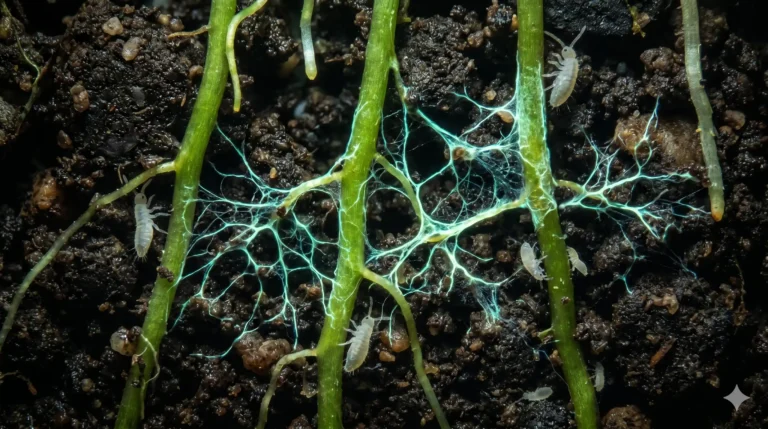
You’ll track Collembola from near-saturated eggs (>95% RH, 15–22°C) with waxy chorions and aeropyles to high-humidity hatchlings (10–20°C) that emerge as miniature adults. You then see successive ametabolous instars, stabilizing chaetotaxy before reproductive maturity, while adults continue molting. Cool, buffered microhabitats and fungal-rich diets maximize growth and fecundity. Males place spermatophores; some lineages use parthenogenesis, often Wolbachia-associated. As key decomposers, they drive C–N cycling and bioindicate soil health—further nuance awaits ahead in each life phase.
Key Takeaways
- Eggs laid in humid microhabitats; require near-saturated moisture (>95% RH) and 15–22°C to develop; development halts if too dry.
- Nymphs hatch as miniature adults with functional furcula; hatching needs >90% humidity and cool, stable temperatures between 10–20°C.
- Development is ametabolous: juveniles resemble adults and pass multiple molts, stabilizing chaetotaxy before reaching sexual maturity.
- Adults keep molting after maturity; reproductive organs form during the subadult stage; fecundity rises with body size and cuticular hydration.
- Most reproduce sexually via substrate-deposited spermatophores; some are parthenogenetic; diapause eggs safeguard embryos during unfavorable conditions.
Eggs: Moisture-Dependent Beginnings
Although adults tolerate broader humidity ranges, springtail (Collembola) eggs require near-saturated moisture to complete embryogenesis. You’ll find females of Entomobryomorpha, Poduromorpha, and Symphypleona depositing small, spherical ova in humid microhabitats—leaf litter, bryophyte mats, or soil aggregates. Each egg’s structure includes a multilayered chorion with waxy epicuticular components and aeropyles that balance gas exchange with moisture retention. Within hours post-oviposition, embryos osmotically imbibe water, swelling 20–50%, a prerequisite for cleavage and germ band formation. Experimental work shows development halts below ~95% RH or at matric potentials above −0.3 MPa. Female secretions and adjacent microbial films further reduce evaporative flux. Clutch spacing minimizes boundary-layer disruption, stabilizing local humidity. Substrate salinity and temperature modulate water activity; ideal ranges cluster near 15–22°C with near-saturated air for egg viability.
Hatching Nymphs: Miniature Adults Emerge
You’ll see Collembola hatching synchronize with high humidity (often >90% RH), stable cool temperatures (~10–20°C), and moisture pulses at the chorion; photoperiod typically exerts little effect in lab assays. You can verify nymph morphology as miniature adults: six legs, 4-segmented antennae, a functional but smaller furcula and ventral collophore, and absent genital openings. You can separate taxa early—Entomobryidae nymphs show elongated antennae and dens, whereas many Onychiuridae hatch aphorculate—and expect molts to refine chaetotaxy and scaling.
Hatching Environmental Cues
When soil moisture rises and temperature falls within a species-specific window, springtail (Collembola) embryos complete organogenesis and hatch. You can diagnose hatching triggers by tracking transient wetting events, cooling fronts, and oxygen diffusion in the litter layer; collectively, these cues synchronize emergence across Entomobryidae, Isotomidae, and Sminthuridae. Pulse hydration restores chorion permeability, reactivates metabolism, and preserves egg viability, whereas prolonged saturation lowers gas exchange and elevates microbial risk. Moderate cooling (often 5–15°C) delays microbial growth yet sustains embryogenesis; abrupt cold suppresses development. You should also consider substrate osmotic potential, CO2 gradients from microbial respiration, and clay content, which modulate water availability at the egg surface. In laboratory cultures, staged misting, aeration, and stable thermal regimes maximize hatch rates while minimizing asynchronous eclosion and mortality.
Nymph Morphology Basics
Hatchling springtails emerge as morphologically conservative nymphs—miniature adults that already exhibit the entognathous mouthparts, four-segmented antennae, ventral collophore, furcula with manubrium–dens–mucro, and tibiotarsal claws with empodium characteristic of their clade. You recognize body tagmosis identical to adults: prognathous head, thoracic legs, and an abdominal furcular complex poised for jumping. Pigmentation, chaetotaxy, and cuticle thickness remain reduced, reflecting early-stage morphological adaptations. Through nymph differentiation across successive molts, you incrementally increase antennal sensilla counts, develop ocellar lenses, and elaborate dorsal setae patterns diagnostic to families. The collophore’s eversible vesicles scale with size, improving osmoregulation and adhesion. Meanwhile, the furcula lengthens relative to body size, and mucro dentition sharpens, boosting escape performance. Growth occurs ametabolously; you add instars without reconfiguring fundamental adult morphology. You retain genital primordia.
Molting Stages: From Instars to Maturity
Across Collembola, postembryonic development is ametabolous: juveniles resemble adults, and each growth increment occurs via ecdysis that continues even after sexual maturity. You progress through discrete instars; instar development includes apolysis, new cuticle synthesis, and shedding exuviae. The maturity shift occurs when gonads and genital papillae become functional, yet you keep molting, adding size and setal complexity. Taxonomically, Entomobryomorpha and Poduromorpha show numerous molts, while Symphypleona and Neelipleona exhibit compact, spherical morphs with comparable sequential stages.
- Early instars: reduced antennal articles, fewer macrochaetae, incomplete furcula.
- Mid instars: chaetotaxy stabilizes; ocelli counts reach adult complement.
- Subadult: reproductive structures develop; manubrium and dens fully sclerotize.
- Adult: sexually mature, but indeterminate molts continue; cuticle thickens per molt.
Molting synchrony remains species-specific and diagnostically useful across taxonomic lineages.
Environmental Drivers: Temperature, Humidity, and Diet
Building on molt dynamics, environmental regimes set the tempo of your instars and the probability of successful ecdysis. Temperature fluctuations modulate metabolic rate; within 8–22°C, Entomobryidae accelerate intermolt intervals, whereas heat spikes increase desiccation risk and cuticular failure. Humidity factors dominate: the ventral tube (collophore) and cuticle require high water activity to maintain plasticity during apolysis. Below 85% RH, you delay molt or die mid-ecdysis. Soil texture and organic content buffer microclimate; fungal-rich horizons supply sterols, nitrogen, and chitin precursors essential for new exuviae. Diet quality governs growth efficiency: feeding on hyphae and biofilms elevates protein assimilation; refractory litter slows instar progression. Isotomidae tolerate cooler, saturated substrates; Sminthuridae favor warmer, structured pores. Manage refuge depth to stabilize gradients. Avoid drought pulses and sudden heat.
Reproduction Strategies: Sexual Cycles and Parthenogenesis
While most Collembola reproduce sexually via substrate-deposited spermatophores, parthenogenesis—typically thelytokous—is widespread and clade-specific. You’ll observe Poduromorpha and Entomobryomorpha with mixed modes, whereas Symphypleona and Neelipleona often show higher parthenogen frequencies. In sexual reproduction, males place micro-spermatophores; females uptake them via the genital aperture, with courtship mediated by antennation and pheromones. Parthenogens bypass mating, shorten generation time, and fix successful genotypes, yet reduce heterozygosity.
- Track oocyte numbers per clutch; fecundity scales with body size and cuticular hydration.
- Note diapause eggs in temperate taxa; chorion thickening protects embryogenesis.
- Compare karyotypes; automixis with central fusion maintains heterozygosity better than terminal fusion.
- Screen for Wolbachia and Rickettsia; endosymbionts bias sex ratios and promote thelytoky.
You’ll recognize shifts with founder effects, clearly highlighting parthenogenetic advantages.
Ecological Roles: Decomposers, Nutrient Cyclers, and Soil Health Indicators
You recognize Collembola—Entomobryomorpha, Poduromorpha, Symphypleona, and Neelipleona—as key decomposers that fragment litter, graze fungal hyphae and biofilms, and comminute detritus. By stimulating microbial respiration and excreting mineral N and P, you accelerate nutrient cycling, alter C:N ratios, and promote rhizosphere aggregation. You also use springtail abundance, trophic guilds, and species assemblages as bioindicators of soil health, tracking pH, moisture, contamination, and disturbance with quantitative indices.
Organic Matter Breakdown
Although minute, springtails (Collembola) drive organic matter breakdown by comminuting leaf litter and grazing fungal and bacterial biofilms across soil and litter horizons. You observe springtail populations concentrating in moist microhabitats, where organic decomposition accelerates via microfragmentation and selective feeding. Entomobryomorpha and Poduromorpha use serrate mandibles to abrade cuticles and cellulose-rich matrices; Symphypleona and Neelipleona shear hyphae, suppressing senescent mycelia and stimulating younger fronts. Fecal pellets, compact but porous, host active saprotrophs and retain moisture, prolonging substrate accessibility. These characteristics make springtails as terrarium inhabitants particularly valuable, as they actively contribute to maintaining a balanced microecosystem. They help in nutrient cycling and prevent the buildup of detritus, ensuring a healthy environment for plants and other organisms. Their presence also enhances soil structure, promoting aeration and moisture retention within the terrarium.
- You’ll notice hyphal pruning increases detrital surface area for colonization.
- Gut passage alters particle chemistry and inoculates fragments with microbiota.
- Cuticle scraping detaches recalcitrant films, exposing fresh plant polymers.
- Density-dependent trampling disrupts aggregates, renewing biofilm edges.
Field assays repeatedly corroborate these mechanisms.
Nutrient Cycling Dynamics
Springtails’ comminution of litter and hyphal pruning scale up to measurable nutrient fluxes, linking detrital processing to mineral availability and soil function. As you follow Collembola across litter and rhizosphere strata, you observe Entomobryomorpha, Poduromorpha, and Symphypleona fragment detritus, graze hyphae, and egest micro-aggregated fecal pellets. These actions enlarge reactive surfaces, accelerate microbial decomposition, and stimulate ammonification and nitrification via excreted NH4+ and mucus. By selectively feeding, they shift fungal:bacterial ratios, alter C:N of substrates during gut passage, and modulate mycorrhizal foraging. The result is tighter coupling of carbon turnover with nitrogen and phosphorus release, enhancing nutrient absorption by roots and saprotrophs. Through top-down control of microbial consortia and reciprocal resource feedbacks, you see robust ecosystem relationships that propagate from microhabitats to whole-soil cycling.
Bioindicators of Soil Health
Because they integrate microhabitat conditions through rapid life cycles and trophic interactions, Collembola serve as sensitive bioindicators of soil health. You assess community composition across Entomobryomorpha, Poduromorpha, and Symphypleona to infer moisture, pH, and organic matter gradients within the springtail habitat. Abundance, age structure, and gut-content profiles reflect detrital quality and interactions with soil microorganisms, fungi. Standardized extraction (e.g., Berlese funnels) and diversity indices (Shannon, Pielou) provide reproducible signals.
- Elevated euedaphic taxa indicate stable, moist aggregates and low disturbance.
- Surface-active forms signal litter continuity and mycelial networks with soil microorganisms.
- Reduced richness and gravid females’ scarcity imply compaction, contamination, or drought stress.
- Rapid rebounds after rainfall reveal resilient food webs and porous structure.
You translate metrics into decisions, prioritizing organic inputs and minimal tillage.
Frequently Asked Questions
Are Springtails Harmful to Humans, Pets, or Houseplants?
No; you won’t suffer harm from springtails (Collembola), and pets remain unaffected. They rarely injure houseplants, grazing roots. Springtails ecology includes detritivory, fungal grazing, nutrient mineralization. Evidence supports springtails benefits as bioindicators and soil engineers.
How Can I Distinguish Springtails From Fleas or Mites?
You’ll distinguish them by morphology and behavior: for springtail identification, note Collembola with furcula-driven jumps, collophore, entognathous mouthparts. Despite flea similarities (jumping), Siphonaptera are laterally compressed, spined biters. Mites (Acari) show eight legs, non-jumping habitus.
Why Do Springtails Jump, and How Does the Furcula Work?
You’ll observe Collembola jump to evade predators and disperse; the jumping mechanism relies on furcula function: a forked appendage locked by the retinaculum, released by muscle contraction and hemolymph pressure, converting stored energy into propulsion.
What Attracts Springtails Indoors, and How Can Infestations Be Reduced?
Like a dial-up modem, you’ll attract Collembola indoors via high RH (>75%), leaks, potted-soil springtail habitats, biofilms, and fungi. Reduce infestations: implement moisture management, dehumidify to 40–50% RH, fix leaks, improve drainage, remove moldy detritus.
What Is the Typical Lifespan and Daily Activity Pattern of Springtails?
You’ll typically see Collembola live 4–12 weeks, extended in humid microhabitats; Lifespan factors include temperature, moisture, and species. Daily behaviors are mostly nocturnal detritivory, negative phototaxis, aggregation, and furcula-mediated escape, with moisture-driven peaks at substrates.